The Problem With Water
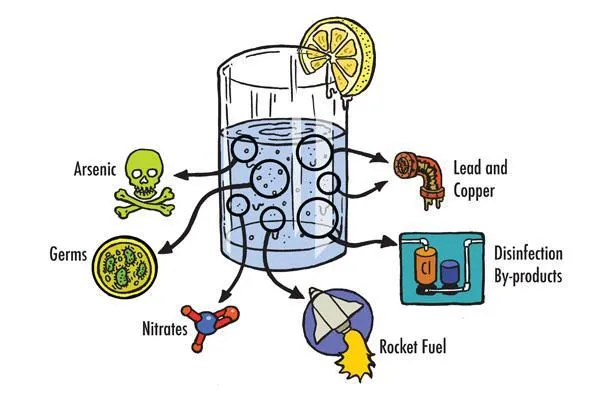
Conceptually ideal water is something like a pristine mountain stream. Rich with minerals like magnesium and calcium, and no contaminants.
Yet, despite being thousands of years old, water today is contaminated with all sorts of poisons, carcinogens, heavy metals, chemicals, plastics, and even drugs.
Evidence
Section titled “Evidence”Some quick facts so you don’t have to take my word for it:
- The American Society of Civil Engineers publishes grades every four years. Our latest scorecard for water (2025):
- drinking water C-
- wastewater D+
-
The Environmental Protection Agency say 20-30% of water utilities don’t even comply with minimum guidelines. EPA SDWIS data and says ~77 million Americans (≈25% of the US population) were served by community water systems that violated the Safe Drinking Water Act at least once in 2015 and the infrastructure hasn’t changed since then.
-
The Environmental Working Group (EWG) has stricter health-based guidelines and pretty much every US utility has at least one contaminant above these. EWG’s 2019 Tap Water Database analysis of ~50,000 systems found ~93% had detected at least one contaminant above their guidelines.
How can this be?! Modern city water was designed decades ago and it was not designed to be optimal. It was designed to prevent bacterial infections that might kill you today — not prevent disease tomorrw.
Now, you might also ask whether the above guidelines are good or bad and the truth is no one really knows. We barely have any idea of how human bodies work.
We take the conservative PoV that instead of guessing what contaminants are healthy we should take the stance that any contaminants are unhealthy until proven otherwise. Simply because when it comes to irreversible health damage, especially for fetuses and children, it is better to be safe than a rat in an experiment.
Here is the kind of stuff that could easily be in your water:
Disinfection byproducts (THMs, haloacetic acids, chloramine). This is a virtual certainty for city water. Austin uses chloramine, which reacts with organic matter in the water to form compounds like bromodichloromethane and chloroform. These are associated with increased cancer risk and reproductive issues.
Heavy metals (lead, arsenic, cadmium, mercury, chromium-6) are the big ones. They bioaccumulate — so low-level chronic exposure builds up over years. Lead is neurotoxic at any concentration (there’s no safe level). Arsenic is a carcinogen, and it’s in our water. These leach from pipes, solder joints, and natural geology.
PFAS (“forever chemicals”) don’t break down in the environment or in your body. They accumulate in organs and blood, and are linked to cancer, thyroid disruption, immune suppression, and reproductive harm.
Pharmaceuticals Detection is widespread.** USGS surveys consistently find pharmaceuticals in 80%+ of sampled US streams (which become source water). Common detects: synthetic estrogens (oral contraceptives), SSRIs (Prozac, sertraline), antibiotics, beta-blockers, NSAIDs (ibuprofen), caffeine, antidepressants.
Microplastics are emerging concerns that aren’t well-regulated or routinely tested. Municipal treatment wasn’t designed to remove them. Brains are estimated to be around 0.5% plastic based on recent, though limited, autopsies and has accelerated 50% over the last 8 years.
You can check your area’s water here tap water database. It won’t tell you what is coming into your home exactly but it’ll give you a baseline for your area.
I’ve tested my water (see proof at the end) and I live in one of the techiest and richest cities in the world.
When you start talking about “optimal” for longevity and “perfect” water in the US… we know it doesn’t exist.
Estimating the cost of this to our society is… difficult. If you look at estimates of direct health issues it’s on the order of 50 billion / year. However, when you think about reduction in health span, intangibles like cognitive impairment, chronic disease, and view it as a contributing factor, its plausible to estimate on the order of 1 trillion / year.
For measurement we use the TapScore Health Guidelines, which pulls every published health-based benchmark for a contaminant from agencies like the - EPA (MCLGs)
- California OEHHA (Public Health Goals)
- WHO
- ATSDR, etc.
The HGL is whichever number is lowest.You can read more about this here. The HGL composite algorithm is also defined here in detail for the water nerds out there.
We can then use their test kit to verify and prove our water meets these guidelines and verify the gap has been closed.
The challenge with your water is:
- Your water is almost certainly polluted
- You cannot rely on the city to clean it up, they do the minimum.
- And, compliance levels are far below optimal.
- And, compliance levels are often NOT even met.
Austin, the capital of Texas has a bunch of junk in it that’s linked to cancer:
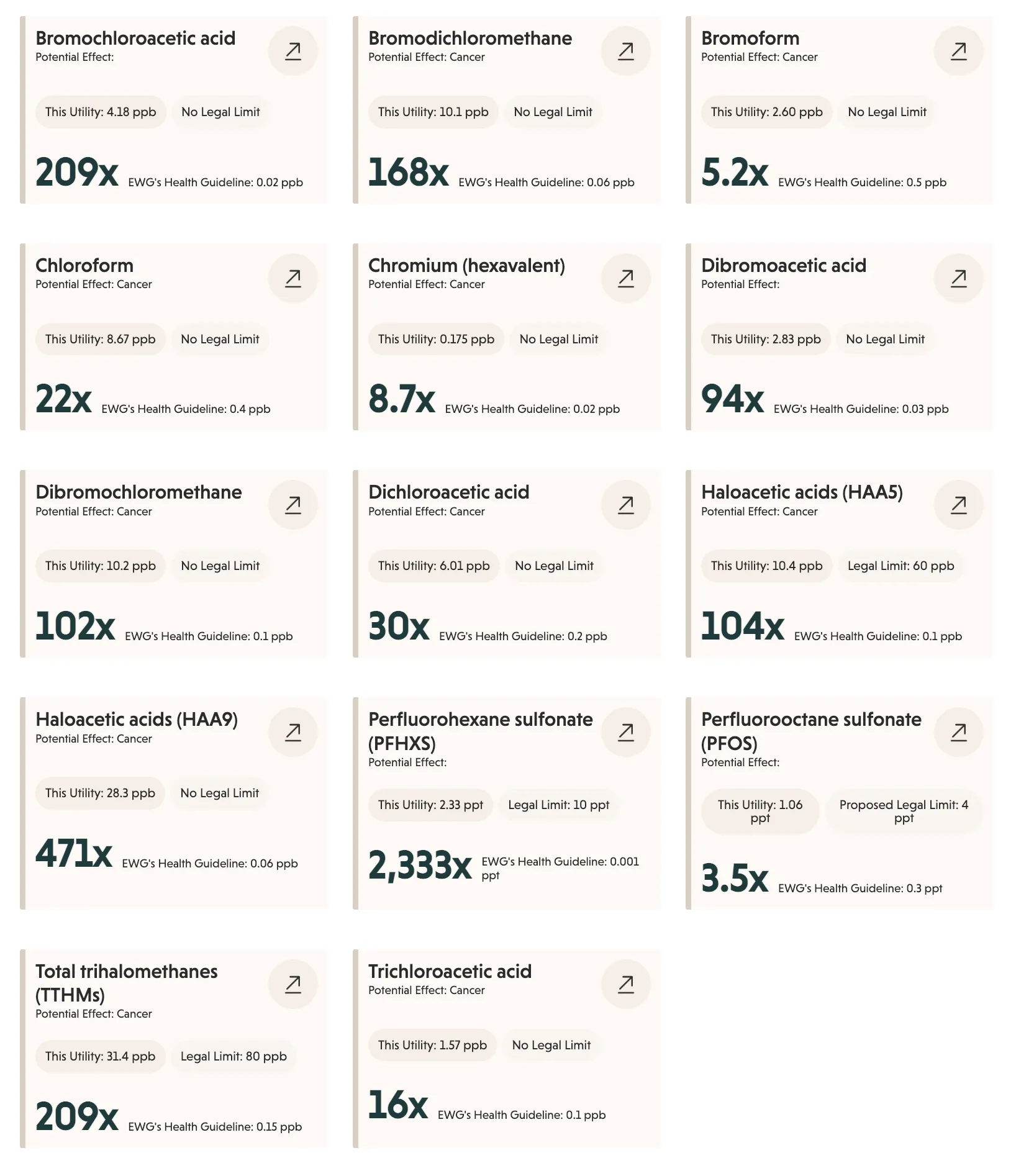
We should be able to install a system and measure as above to verify and prove our water meets these guidelines and verify the gap has been closed.