The Problem With Light
Light is possibly the most overlooked, but most powerful automatic health and performance lever available.
Why? Light regulates our biology, and therefore is upstream of everything we do, including sleep. Which in turn is upstream of health, performance, learning, and fitness.
Sadly, 99% of modern lights are junk and we don’t even realize it. That is why fixing your light, ensuring it’s optimal, is such a big opportunity.
Evidence
Section titled “Evidence”Bad light is a big deal:
- Cardiovascular. A 2025 UK Biobank study of ~89,000 adults wearing wrist light sensors found people with the brightest nighttime exposure had up to a 50% higher risk of heart failure, atrial fibrillation, coronary artery disease, and stroke — independent of standard risk factors. (JAMA Network Open, 2025)
- Mortality. Same cohort, separate analysis: brighter nights and darker days predicted higher all-cause mortality across 9.5 years of follow-up. (PNAS, 2024)
- Diabetes. A single night of moderate room light during sleep impaired insulin sensitivity and cardiovascular function the next morning. Larger studies find every 10-lux increase in nighttime light raises type-2 diabetes risk roughly 30%. (PNAS, 2022; Northwestern, 2022)
- Cancer. Meta-analysis of 734,000 participants: light at night raises breast cancer risk (RR 1.12), with a dose-response curve. The IARC classifies night-shift work as probably carcinogenic to humans (Group 2A) — citing breast, prostate, colon, and rectal cancers. (Frontiers Public Health, 2023; IARC Monograph Vol. 124, 2019)
- Hair-trigger sensitivity. Half of melatonin suppression happens at only ~25 lux — dimmer than a single household lamp. The “warm” bulb on your nightstand is more than enough to keep your body clock awake. (Chronobiology International narrative review, 2023)
- Eyes (children). Outdoor light is 11–43× brighter than indoor light. Increasing outdoor time from 1 to 3 hours per day cuts childhood myopia risk by roughly 50%. (Literature review, 2020)
From both first principles and empirical observations we can see that poor light has a profound impact on you. These effects compound year over year.
The infrastructure that should be giving us health by default is silently degrading us. The confusing part is light comes in many form factors, with many spectrums, and many jargon terms.
So, the first thing we need is a clear mental model of what good light is.
What Makes Good Light
Section titled “What Makes Good Light”We evolved under a giant burning ball. Our eyes learned to treat its particular mixture of wavelengths as “true” for color perception and to use its spectrum, in its particular quantities, to regulate our sleep/wake cycle.
So all that matters is your biological response to that mix — captured in a chart called the spectral power density (SPD).
Scientists have plotted out two key response curves over the spectrum:
- the circadian response (drives your sleep/wake cycle)
- the visual response (drives how accurate color looks)
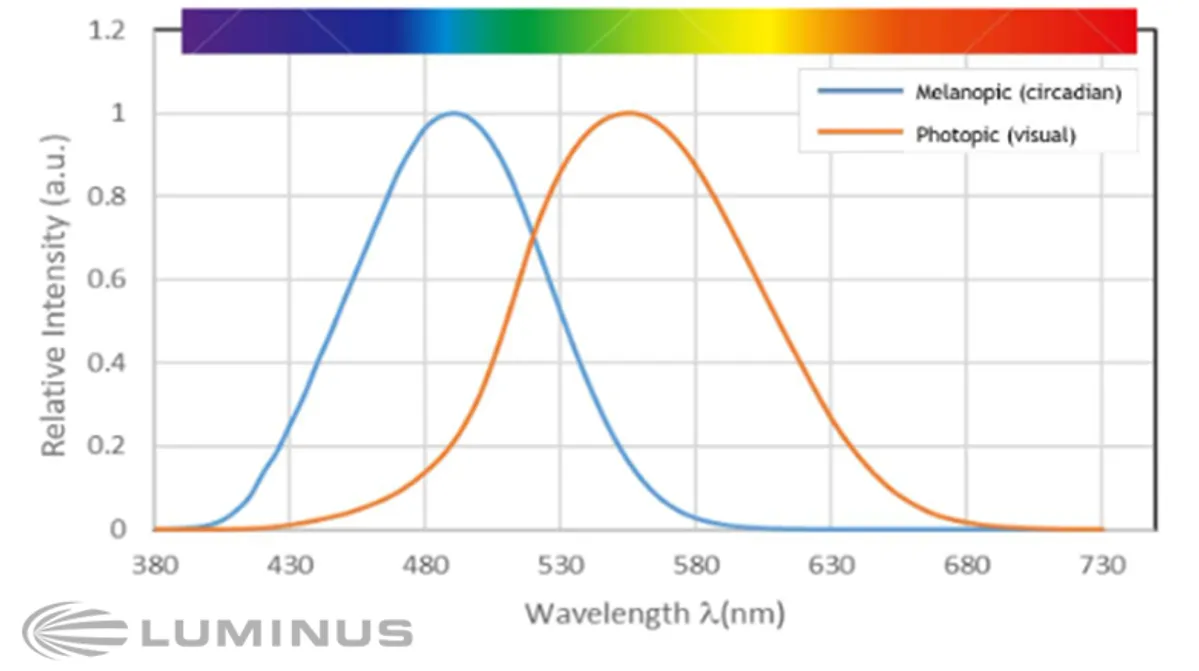
To have good light we want to “color in” both curves during the day, then fade them out to the right over the evening.
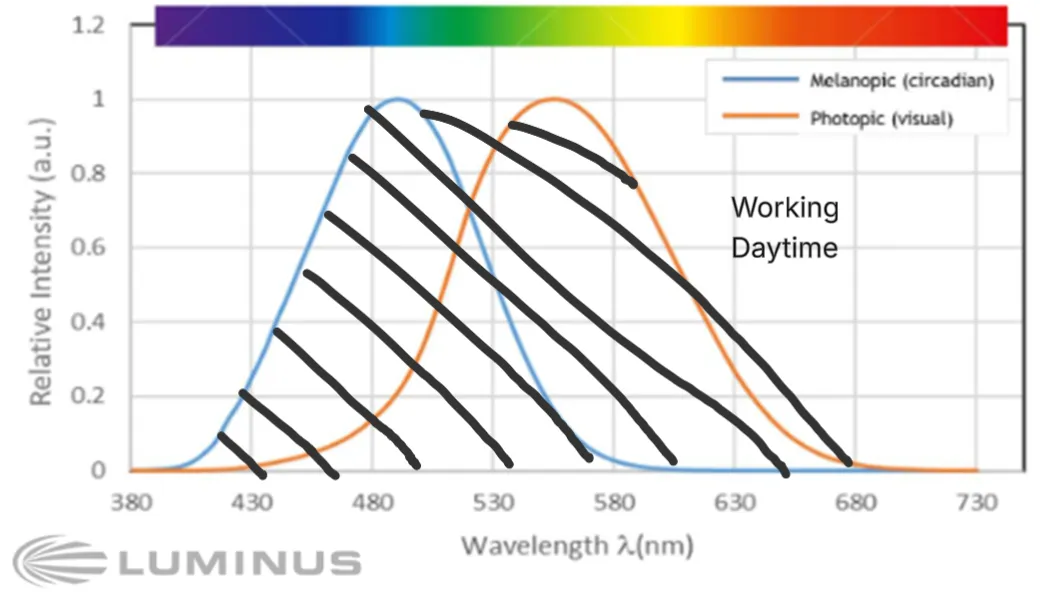
The sun does this optimally:
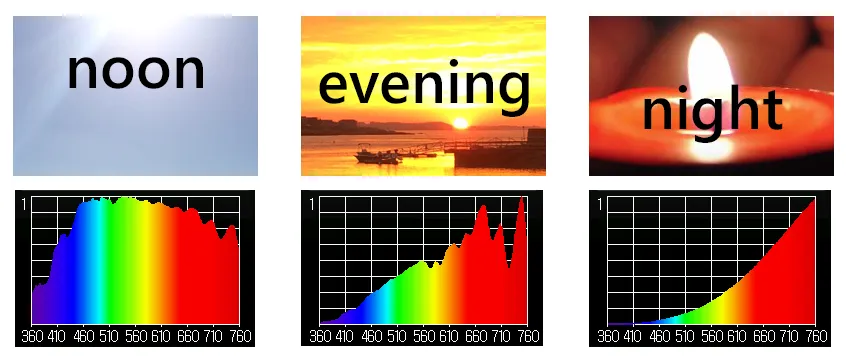
It fills out both curves by day and smoothly shifts right over the evening, giving us a clean cycle.
Artificial light is nothing like the sun:
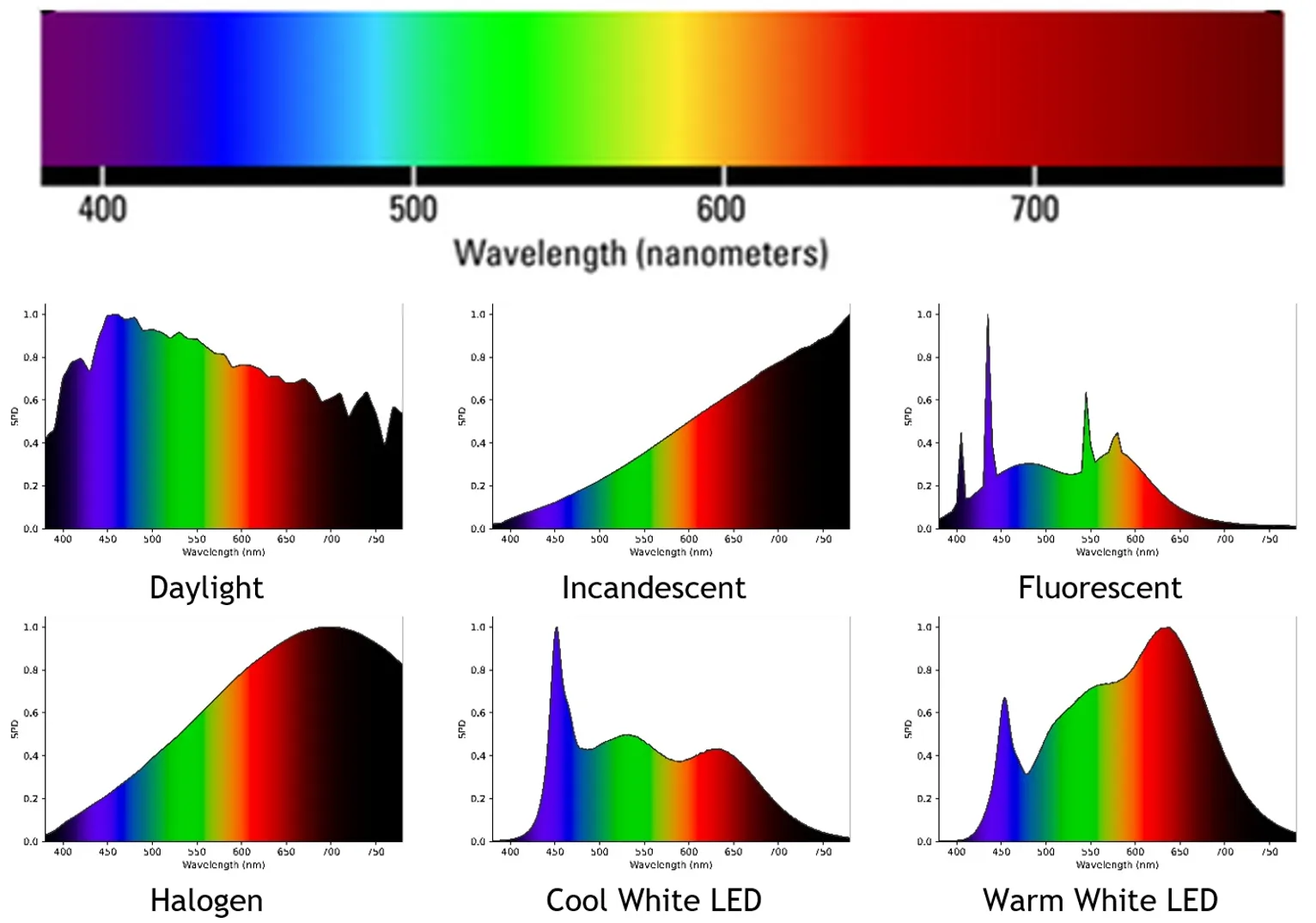
And a typical LED transitions through the day like this (with the circadian response curve roughed in):
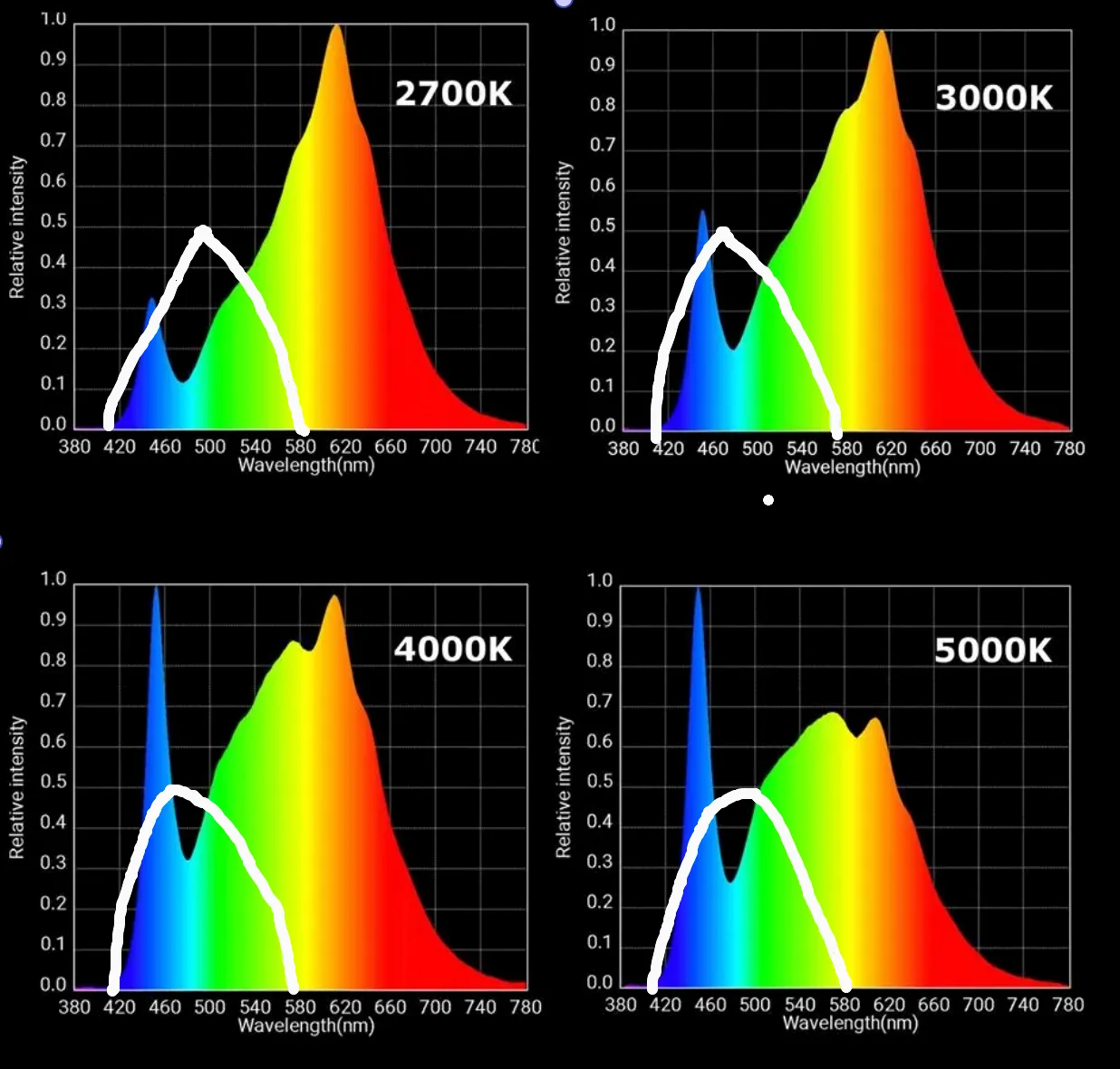
Your “warm” light is helping, but not nearly as much as you’d hope.
Cheap Tricks
Section titled “Cheap Tricks”Unfortunately, most vendors rely on:
- Buzzwords — CRI, color temperature, “circadian” bulb, “blue-light-blocking.” Most of these don’t tell you anything meaningful about the actual SPD.
- Temperature hacks — making light look warm at night without acting warm. The bulb appears amber to your eyes but still floods the circadian curve.
Here’s the giveaway. Compare a “warm” 3000K bulb to a 4000K bulb against the melanopic curve. The eye perceives them as very different, but the circadian system barely notices the difference:
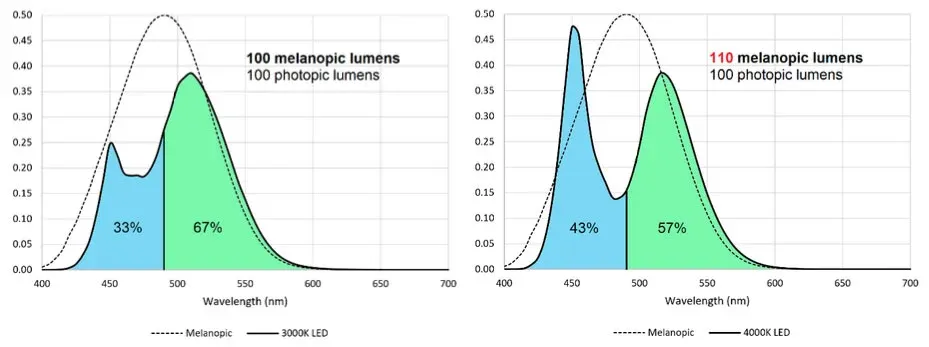
A 3000K “winddown” bulb still fills a large portion of the sleep/wake curve. When you should be at 10% or 1% getting ready for bed, your biology thinks it’s mid-afternoon.
Maybe your insomnia isn’t a you problem. It’s a light problem.
It’s All About the SPD
Section titled “It’s All About the SPD”If a vendor won’t publish the SPD chart, they’re untrustworthy. Without it, you have no idea what you’re actually getting — only what the marketing wants you to think.
This is just as true for screens. “Night mode” on phones and monitors uses the same temperature trick: tints the display amber but leaves the underlying LED spectrum mostly intact.
Bad Light Quality
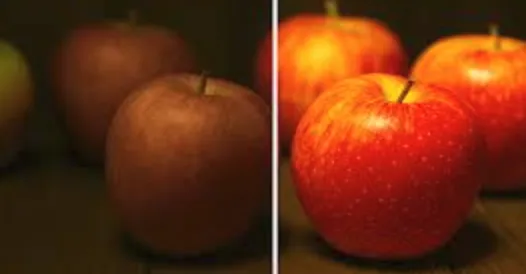
Section titled “Bad Light Quality”The circadian story is half the picture. The other half is visual quality — you need bright, sun-like whites for accurate color rendering. Otherwise everything from food to skin to fabric looks slightly wrong.
Not That Smart, Not That Good
Section titled “Not That Smart, Not That Good”Spectrum aside, even the “good” smart bulbs fail at the basics.
A storm knocked the power out at our place. When it came back on at 2 AM, every Philips Hue bulb in the house blazed back to full bright white — the default state. At $50 a bulb, that’s an expensive way to ruin a night of sleep.
Smart lights just aren’t that smart:
- there’s always at least one bulb that misses a transition
- state changes throughout the day take fiddly config
- the light isn’t really yours — no open API, vendors can revoke features
- everything requires a hub or app, and only supports narrow standards
- one-by-one setup with losable QR codes
Optimal light is simple. Fill the SPD curves by day, fade right by night.
Daytime:
Sunset:
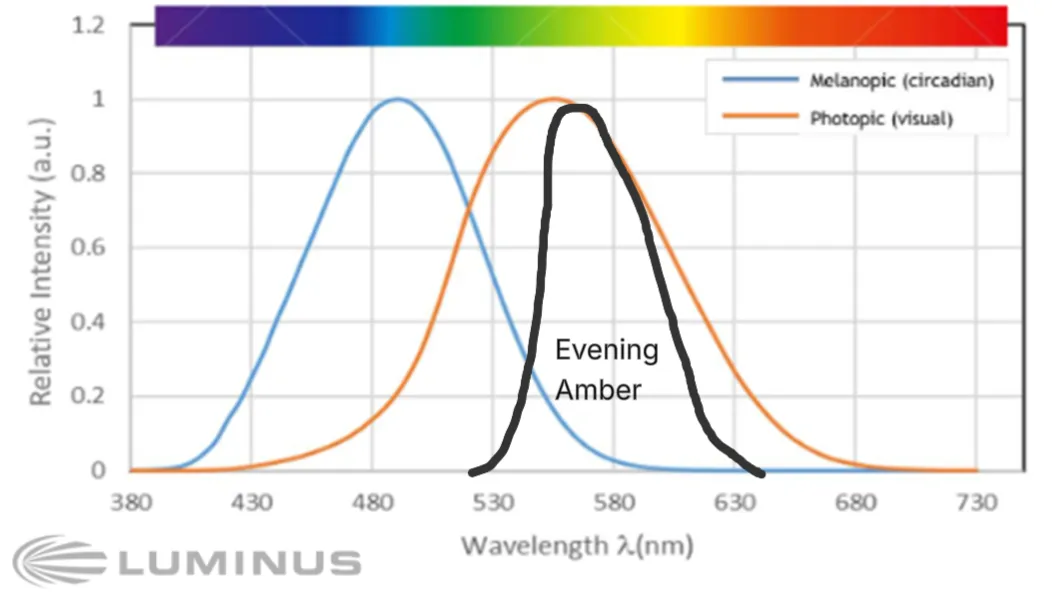
Nighttime:
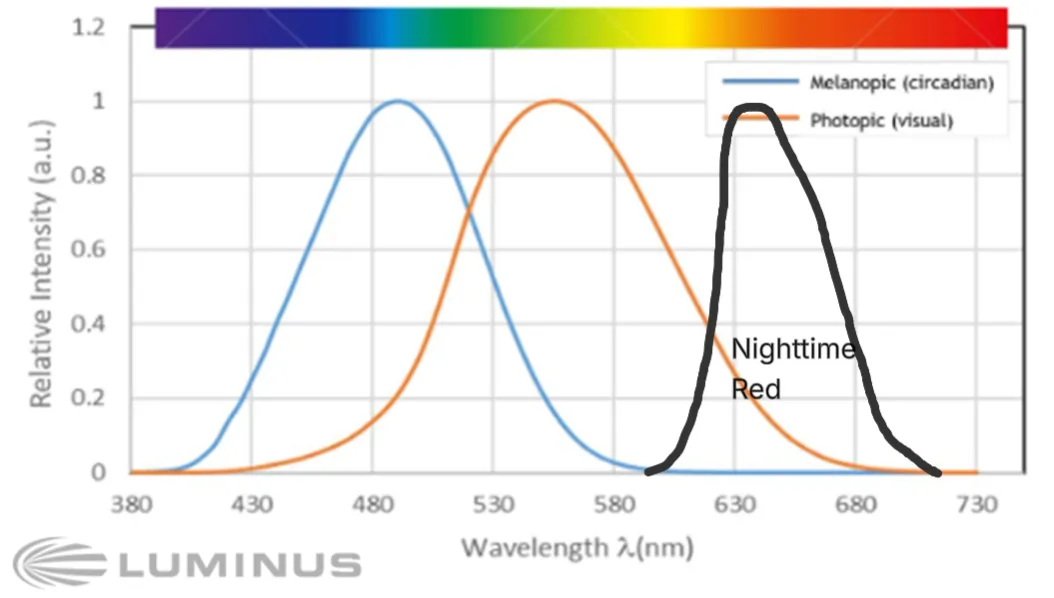
We want these curves to run perfectly, day in and day out. We want full ownership over the devices with local control. In a magical world our lights could do more than just mimic sunlight they could also communicate with your house to indicate emergencies or to adjust the lighting to match the ambient conditions.
There isn’t a single light fixture that gives you everything. We have to make tradeoffs between:
- optimal spectrum
- circadian timing
- reliability
- intelligence
- ownership
- open, flexible control
- cost
Even if there were perfect lighting system, swapping bulbs doesn’t fix the phone and monitor in your face for ten hours a day — same LEDs, same problem.