Water
Problem
Section titled “Problem”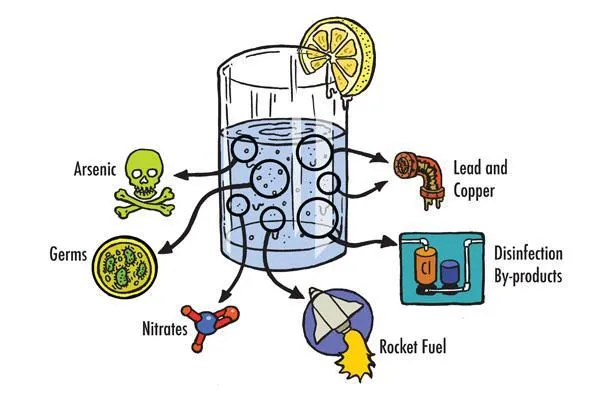
Do you know whats in your water? If you don’t, you are not alone, almost no one does. Water is something we take for granted. With good reason! It’s been a foundation of civilization since man stacked bricks together.
Yet, despite being thousands of years old, water treatment is contaminated with all sorts of poisons, heavy metals, chemicals, plastics, and even drugs.
How can this be? Simple, city water was designed decades ago and it was not designed to be optimal. It was designed to prevent bacterial infections that might kill you today and is a bare step up from aquaducts Romans built.
Don’t believe me? You don’t have too!
The governement and a bunch of groups already say how terrible our water is for me.
- The American Society of Civil Engineers publishes grades every four years. Our latest scorecard for water (2025):
- drinking water C-
- wastewater D+
-
The Environmental Protection Agency say 20-30% of water utilities don’t even comply with their bare bone guidelines. EPA SDWIS data and says ~77 million Americans (≈25% of the US population) were served by community water systems that violated the Safe Drinking Water Act at least once in 2015. And like I said, the infrastructure hasn’t changed since then.
-
The Environmental Working Group (EWG) has stricter health-based guidelines and pretty much every US utility has at least one contaminant above these. EWG’s 2019 Tap Water Database analysis of ~50,000 systems found ~93% had detected at least one contaminant above their guidelines.
You can check your area with their tap water database. It won’t tell you what is coming into your home exactly but it’ll give you a baseline for your area. Why? Miles of pipe and pump stations can sit between the treatment plant and your tap. These pipes are often decades old — or, worse, brand new and still leaching material into the water.
Make no mistake our water is seriously fucked up. I’ve tested mine and I live in one of the techiest and richest cities in the world.
Here is the kind of stuff that could easily be in your water:
Heavy metals (lead, arsenic, cadmium, mercury, chromium-6) are the big ones. They bioaccumulate — so low-level chronic exposure builds up over years. Lead is neurotoxic at any concentration (there’s no safe level). Arsenic is a carcinogen. These leach from pipes, solder joints, and natural geology.
Disinfection byproducts (THMs, haloacetic acids, chloramine). Austin uses chloramine, which reacts with organic matter in the water to form compounds like bromodichloromethane and chloroform. These are associated with increased cancer risk and reproductive issues. Austin’s levels are within legal limits but 100–200x above EWG’s health-based guidelines.
PFAS (“forever chemicals”) don’t break down in the environment or in your body. They accumulate in organs and blood, and are linked to cancer, thyroid disruption, immune suppression, and reproductive harm.
Pharmaceuticals Detection is widespread.** USGS surveys consistently find pharmaceuticals in 80%+ of sampled US streams (which become source water). Common detects: synthetic estrogens (oral contraceptives), SSRIs (Prozac, sertraline), antibiotics, beta-blockers, NSAIDs (ibuprofen), caffeine, antidepressants.
Microplastics are emerging concerns that aren’t well-regulated or routinely tested. Municipal treatment wasn’t designed to remove them.
Minerals at excess — not toxic per se, but Austin has hard water that affects everything downstream.
When you start talking about “optimal” for longevity and “perfect” water in the US… we know it doesn’t exist, even putting the above aside, every municipality puts disinfectants in their water. Make no mistake, tap water is trash water.
Estimating the cost of this to our society is… difficult. If you just look at direct health issues it’s on the order of 50 billion / year. Not so bad for the US. However, when you think about reduction in health span, intangibles like cognitive impairment, chronic disease, and view it as a contributing factor, its plausible to estimate on the order of 1 trillion / year.
That’s a staggering number. You’d think that we’d upgrade water everywhere as an investment but we don’t do ambitious projects anymore.
Many will write these facts off, but it’s not all bad. It means you and me get an IQ point advantage and get our lawns mowed for cheap.
Ideal water is something like water from a pristine mountain channel. Rich with minerals, no contaminants, no bacteria, no parasites, no poisons, no plastics, no nonsense.
Putting numbers to it, something like:
| Spec | Target |
|---|---|
| Total Dissolved Solids (TDS) | 50–150 mg/L |
| Calcium | 30–80 mg/L |
| Magnesium | 20–50 mg/L |
| Bicarbonate | 50–200 mg/L |
| pH | 7.0–8.0 |
| Sodium | ≤20 mg/L |
| Total Organic Carbon (TOC) | ≤0.5 mg/L |
| All other contaminants (PFAS, DBPs, metals, microplastics, fluoride, pharma) | Non-detect |
- You cannot rely on the city. Governments have little incentive to care about your optimal biological health — they care about meeting compliance levels.
- Compliance levels are far below optimal.
- Compliance levels are often NOT met.
- We have no idea what is actually coming into our body.
Solution
Section titled “Solution”A two-tier model:
- Whole-home basic filtration
- Reverse osmosis and remineralization for drinking water
This will get our drinking water to our goal metrics though we will need to supplement magnesium (you have to anyway in most places).
System
Section titled “System”Luckily fixing your water is simple. The hardest part is remembering to change the filters every year.
Bare Minimum
Section titled “Bare Minimum”Recommended
Section titled “Recommended”In addition to the minimum we personally recommend:
Why test if you can look it up? It’s worth knowing exactly what comes into your tap since it has to pass through potentially miles of pipe and multiple pump stations to reach your faucet.
Why a whole home filter? Because you also get polluted when you shower or bathe or brush your teeth. Nothing like choloform gas for a healthy body! Bad water impacts skin health, hair, and general health.
We run our own RO system and have tested the difference at the tap from theperfectwater.com
TODO: pending total table of results
There are likely other RO systems out their just as good this is one we happened to find a few years ago and was recommended by a friend.